I began as a teenager trying to understand the rough edges of Yahoo Chat. What followed was a workshop of programs, a public website, and a community that made the Internet feel much bigger than the room behind my parents’ couch.
Surviving evidence: the recovered source tree. The archive is preserved for research; recovered applications are not run or distributed.
689,302files catalogued
46,976folders catalogued
3 + laterEP-era releases / c0ld.net continuation
10chapters in this story
01
Origins
I remember making my first website in 2000, when I was about fifteen or sixteen. Shaggy’s “It Wasn’t Me” seemed to be constantly on MTV. That detail is not in a log file or a timestamp; it is simply the sound I associate with learning that I could put something on the web and let strangers find it.
The first version was made with a Tripod page builder. In my memory it was black and pink and looked exactly like something a teenager would make with a page builder at the turn of the millennium. It did not survive as a screenshot. The next address I remember was eliteprodigy.cjb.net, forwarding people toward the site, before I rebuilt the whole thing at eliteprodigy.com.
I had spent months reading security text files and searching Astalavista. Much of what I found was already old or patched. Yahoo Chat was different. People were doing things in real time: pushing a client until it froze, disrupting a room, working around the limits of the service. I wanted to know what was happening underneath the button.
02
A Weekend
The computer was in the living room, behind the couch. Dial-up took the phone line. I would settle into a chair that had seen better days, put on CDs, smoke too many cigarettes, and disappear into the work from Friday until Sunday. The Chemical Brothers’ “Hey Boy Hey Girl” is one of the songs that still brings the room back to me.
The archive cannot prove one remembered weekend. Filesystem dates have been copied, restored and carried across machines. What the source does show is accumulation: forms, modules, test projects and half-finished ideas surrounding applications that became very large. That physical density is the documentary counterpart to the memory.
On Monday mornings I told friends about whatever I had built. This is one of the rare places where recollection and contemporary writing meet cleanly. The Darks Revenge readme thanks ppk_ie and eieioie for putting up with me on the school bus while I talked about what I had made over the weekend. Dale and Alan are the first names I remember from that scene; I am not publishing anything more identifying than that.
The room was ordinary. The feeling that I could make anything was not.
The story is not that every weekend produced a masterpiece. Most produced experiments, damaged backups and code I would write differently now. The important part was the habit: I kept returning to the chair and making the next thing.
03
I Did What I Set Out to Do
I did not begin because I wanted a tidy software career. I began because I had seen a tool do something I did not understand. Downloading somebody else’s program was not enough. I wanted to take the idea apart and build it myself.
The surviving Darks Revenge readme thanks people who helped me learn Visual Basic. The recovered project collection then shows the learning spreading outward: Windows messages, controls, timers, sockets, web requests, protocol parsing, installers, graphics and interfaces. By the time I reached Insane Chat, I was no longer automating one narrow action. I was trying to recreate an entire chat experience.
I remember getting into a state of flow and holding the overall shape of a program in my head. I formatted and assembled a great deal by hand because that was how I knew to work. There was no source control in my process, which is why the archive contains folders that are best understood as backups, damaged copies and experiments instead of clean branches.
04
Darks Revenge
Darks Revenge was my first real program, and its main purpose was a Yahoo booter. The contemporary readme says that plainly. I should not hide it behind the utilities that grew around it or recast it as defensive research now. It was made to disrupt other people’s sessions, and people could be harmed by using it.
The first source boundary is damaged: a project manifest survives, but its declared members do not survive at the exact paths written there. Darks Revenge 2 is different. I remember deliberately rewriting and greatly expanding it, and the preserved project supports that memory. Its manifest declares 103 forms, 28 standard modules and four classes. Researchers counted 51,702 physical source lines, about 34,654 code-side lines and 2,323 procedures, events and functions.
It was a Yahoo booter first and a toolbox second. Around the core were chat controls, talkers, utilities, scanners, customisation, screen and window handling, automation and defensive features. Some of the accompanying material crossed a further line into deceptive remote-control behaviour. That remains part of the record, described without instructions, payloads or downloadable software.
I was the principal author, integrator and publisher, but not everything inside was mine. The readme credits dark_side_kicks_ass with “99% of the boots”—the boot codes, not 99 percent of the application. noonxnoon made Big Talker. Krisco420 helped me learn Visual Basic. Ur_Dead_Again2001 supplied inspiration and help. Silas_of_Zeal, also remembered as Gaspar of Zeal, was a close friend and programming peer. Mechacode7 stayed through the all-night work as a friend and companion, not as a programmer.
The program also used an unlicensed commercial skinning control. The integration was substantial; the licensing was wrong. The public archive can acknowledge both without reproducing the old bypass instructions or distributing the component.
I am proud of the learning and the fact that I shipped it. I am not proud of harming people.
I remember Darks Revenge and Darks Revenge 2 as public releases. Contemporary Elite Prodigy pages and package material independently support public distribution. A surviving click record shows activity, but it does not prove completed downloads, unique users or runtime quality. The honest achievement is end-to-end: I built, packaged, published and supported a large program over dial-up. The honest ethical account is that I did so around a harmful core.
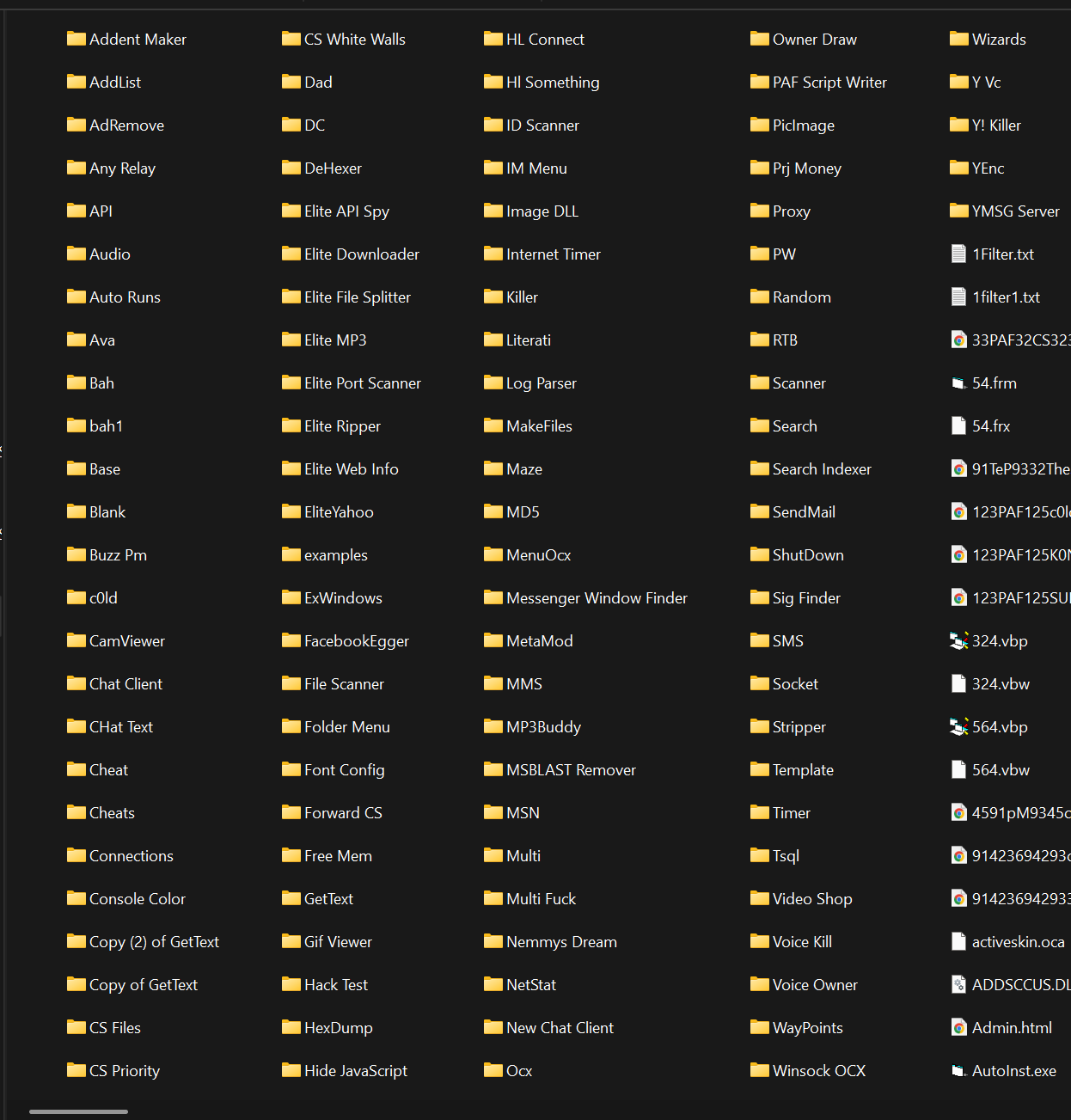
The archive is much larger than three Elite Prodigy-era releases. It contains chat clients, file and media systems, developer tools, network experiments, protocol components and tiny tests. I do not see the unreleased work as a cupboard full of failures. It is the workshop: evidence of learning, trying and building because I wanted to build.
The recovered source has changed my sense of its scale. Elite API Spy followed the cursor into Windows handles and generated reusable VB code. Fire Gate joined network tables to processes and could suspend a program while the user chose whether to allow it. Elite Ripper coordinated a CD drive, audio extraction, MP3 encoding and tags. Elite MP3 added playlists, ID3 parsing and a spectrum visualiser. File Splitter completed the quieter job of dividing and reconstructing large files.
Some of the smaller projects are just as revealing. Free Mem used deliberate memory pressure and release as a period Windows technique. Any Relay reduced a two-way socket relay to a tiny working core. Components such as ProMenu and a custom Socket OCX show that I was also making my own building blocks.
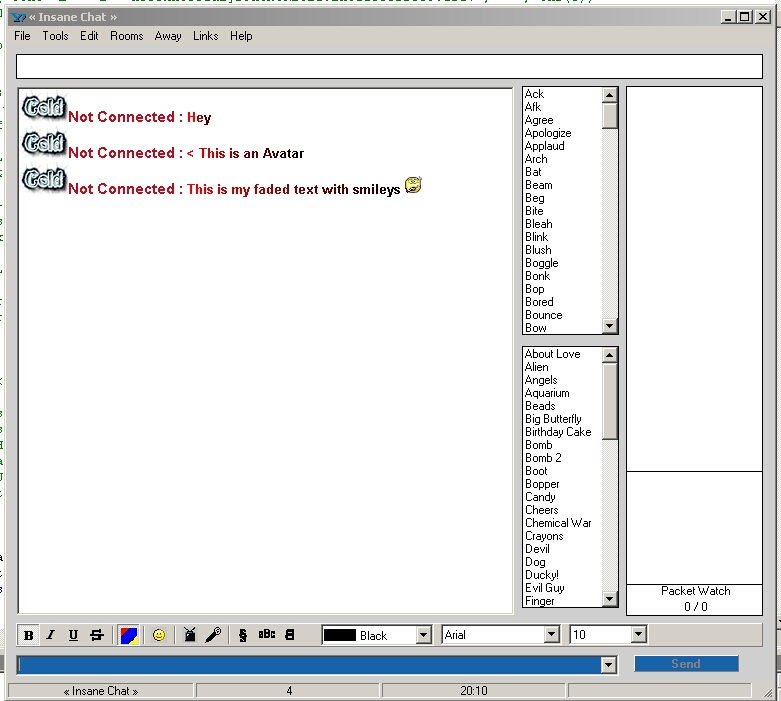
Insane Chat is the centre of that workshop. The preserved source establishes a substantial direct Yahoo Chat client using YCHT. It handled room chat, private messages, formatting, user state, sounds, smileys, images and an anti-spam system. The source also shows an incomplete move toward YMSG. My memory is that it offered the user-visible feature set I associated with Yahoo Messenger; that is not a claim that the preserved version implemented the complete YMSG protocol.
One anti-spam rule looked for repeated chunks inside incoming text. I remember designing that particular rule with a marker on the back of cardboard boxes while selling strawberries at the roadside. The code proves the repeated-chunk rule. It cannot prove where I wrote the idea down.
The feature I was proudest of was putting pictures inside a VB6 RichTextBox. I remember finding an online snippet and being astonished that it was possible. The active source explicitly credits VBElite for the underlying conversion technique. My work is visible in the integration: parsing, retrieving and caching images, inserting smileys and avatars, formatting links and text, triggering sounds and rendering the transcript as one experience. I did not invent the conversion trick; I made it useful inside the client.
The preserved 1.5 source contains substantial voice work, but its own interface still says voice was unfinished. I remember voice working in a later stable release, but no complete later source boundary has been established. A contemporary page announces version 1.7.1; it may continue from this tree with a stale manifest, or later source may be missing. The site does not collapse that uncertainty.
Insane Chat, surviving screenshot. Publication approved by Jay. It supports the source-backed account of a graphical Yahoo-style client; no historical endpoint was contacted to preserve or show it.
06
Elite Prodigy
Elite Prodigy became the public home for the work: news, software pages, downloads, forums, statistics, Top Sites, fan art, affiliates and eventually product-specific material such as the Insane Chat site. It was not one fixed design. It changed as I learned and as the community grew around it.
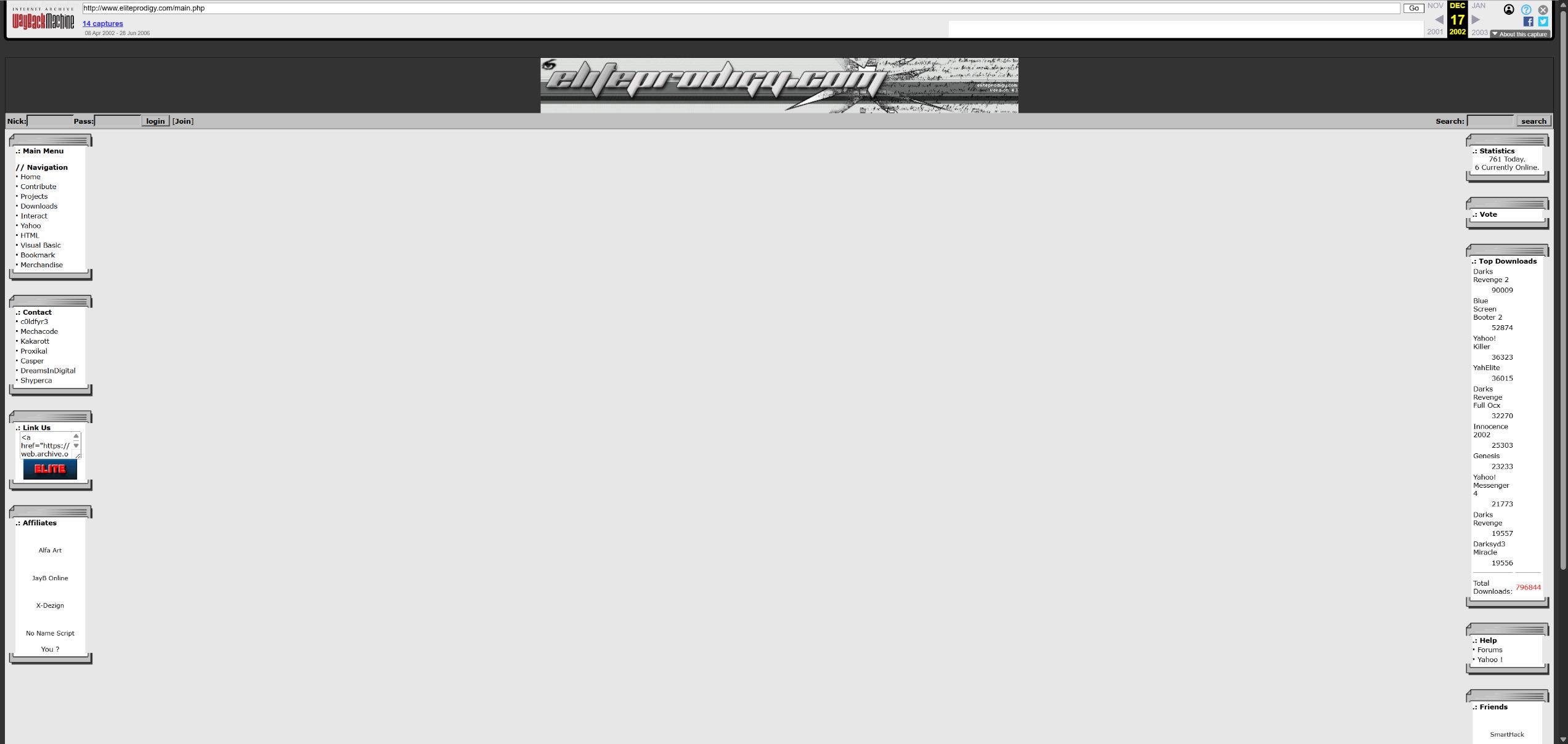
The Wayback record gives the surviving visual spine. Late 2001 is black, dark gray and red, with a Flash introduction calling the site a place for Yahoo programs and Visual Basic help. In 2002 it becomes a pale lavender, table-built portal with menus on both sides, news and visible counters. Late 2002 and 2003 bring a sharper silver shell and multiple authors. Forums and Top Sites remain visible into early 2004. By June and October, the root resolves to domain parking.
An archived page from 8 April 2002 displays 11855 Today, alongside nine people currently online, a hit-counter image labelled 187,917 and a download total of 336,698. Those are exactly the values the page shows. I remember the 11,855 figure as unique visitors across the whole site, but the counter implementation has not survived, so the meaning stays recollection rather than analytics fact. The displayed download totals are counters, not proven completed or unique downloads.
Top Sites was partly practical and partly play. I remember it as a way for people to discover related sites, a reciprocal-traffic system, and something I built because I could. Fan art was an open submission area. The surviving subsystems show that the site was more than a software shelf: it was a small public ecosystem with its own navigation, visibility and people.
The silver era, December 2002. A genuine Wayback replay captured during this preservation pass. Missing third-party images and inactive links are treated as part of the incomplete web record.
07
The People Who Kept It Alive
The software did not arrive online by magic. People taught, supplied material, wrote components, stayed awake, hosted files, uploaded packages, tested, moderated, reviewed, mirrored, made art and simply made the place feel inhabited.
The right way to credit that history is through specific verbs. A greet is not automatically a development contribution. An affiliate is not automatically a friend. A public handle does not give me permission to infer somebody’s real-world identity. Where a contemporary readme names a contribution, this site preserves it. Where I remember a friendship, it says that the source is memory.
Gaspar of Zeal and Silas_of_Zeal were the same person using different handles. He was a close friend and programming peer, building Y!Zeal while I built my work. The archive keeps both historical names attached to the source in which each appeared. Mechacode7’s contribution mattered differently: he was the friend who stayed through the nights and let me test, not another programmer.
dvx_usa is credited with hosting and general help. Sholin1284 is credited with extensive uploading and distribution. I also remember a separate, anonymous person who hosted program files for a long period; I cannot responsibly attach a name. That gap does not prevent the story from acknowledging the invisible infrastructure.
I remember one phone bill reaching roughly four hundred Irish pounds. Dial-up was expensive, the line was always occupied, and none of this looked like an obvious investment from the outside.
My dad supported it quietly. He defended the phone bill because the computer and the Internet mattered to me. There is no contemporary document that proves a private act of faith like that, and I do not want to manufacture one. The surviving archive is what stands beside the memory: hundreds of thousands of files that exist because I was given the space and time to keep learning. I do not believe I would be where I am today without that support.
He did not explain himself. His decision to keep paying was the explanation.
09
The End
There was no final post that tied everything together. The silver site was still alive in 2003, with news from multiple authors. Forums and Top Sites remained visible in early 2004. Then the root started resolving to a parked domain. The contemporary record gives that external sequence; it does not give a single emotional ending.
I remember losing interest in maintaining the site as my attention moved elsewhere. I also remember losing the domain and my Yahoo identity at roughly the same time, but I do not trust the exact order now. The archive does not force one.
Later I built Counter-Strike tools under c0ld.net. That work belongs after Elite Prodigy rather than inside its release list. The public site was over. The habit that created it was not.
The site ended. The building did not.
10
What Survives
What survives is untidy: source projects beside backups, websites beside database fragments, screenshots, old installers, readmes, assets, half-finished experiments and timestamps that cannot always be trusted. Preservation began by making a read-only catalogue and separating canonical metadata from a working mirror used for safe text inspection.
The result is not a runnable nostalgia package. No recovered executable or archive is offered here. Potentially harmful features are described historically and non-operationally. Private information remains closed. A feature is not called shipped just because a menu label or binary filename survives.
That restraint does not make the archive lifeless. It lets the real scale show without mythology. Three programs are remembered as public releases during the Elite Prodigy era; XP Search is independently evidenced as a later c0ld.net release. Dozens more survive as private projects, experiments and prototypes. The website moved through at least three documented visual eras. Credits preserve a community that cannot be reduced to traffic counters. And inside the source are the mistakes, borrowed pieces, ambitious integrations and abandoned routes that make the work recognisably mine.
What surprises me now is the dedication of that younger version of me: writing complete programs with grand ambitions even when they might never see the light of day, simply to learn. Today I cannot imagine working in quite the same way. Those applications were not failures because they did not become public products. They are the record of learning what I could make. The archive lets me see the workshop again—and this time, keep it.
“I did what I set out to do: I learned enough to build it myself.”
Jay / present-day recollection, reconciled with surviving source